

What Actually Changed in 2025, and what leaders should prepare for in 2026
Why this article exists
2025 produced more AI headlines than any executive can digest. Many were breathless. Some were misleading. A few mattered.
This piece is for senior leaders who don’t want the hype cycle. They want the signal:
- What moved the frontier in 2025 in ways that can change operating models?
- What is likely to become “normal infrastructure” in 2026?
- What should boards and executive teams do now, without falling into pilot theater or tech shopping?
I will keep this grounded. If a statement cannot be reasonably verified, it won’t be stated as fact.
Executive summary for boards
Three things defined AI’s real progress in 2025:
- Reasoning became productized, not just researched.
Large AI providers increasingly shipped “reasoning-forward” models and controls to tune deliberation. OpenAI, for example, released the cost-efficient reasoning model o3-mini (Jan 31, 2025) with explicit controls for reasoning effort and developer features such as structured outputs and function calling. (OpenAI Help Center)
- Agents shifted from demos to early operational use cases — but the ROI reality check also arrived.
Many companies still struggled to turn broad GenAI deployments into measurable profit or productivity at scale. Reuters reported (Dec 16, 2025) that surveys from Forrester and BCG found only a minority of firms reporting meaningful improvements, and described the “jagged frontier” problem: AI can be brilliant in one task and unreliable in the next. (Reuters)
- Governance started moving from “policy documents” into technical architecture.
2025 saw increasing practical uptake of risk frameworks and public-sector governance patterns. NIST’s Generative AI Profile (NIST AI 600-1, released July 2024) continued to serve as an enterprise-ready way to structure GenAI risk management. (NIST)
The OECD documented real public-sector AI use across countries and emphasized trustworthy adoption and guardrails. (OECD)
Looking to 2026, Forrester’s headline prediction is blunt: enterprise software will evolve from tools that support humans to systems that accommodate a digital workforce of AI agents, and technology leaders will have to decide “how far to go” in digitizing processes independent of human workers. (Forrester)
That creates a leadership agenda: where to allow machine agency, how to retain human authority, and how to build auditable, resilient agentic operations.
2025 wasn’t “bigger models.” It was models that could be run like systems.
Public conversation still over-rotates on model size. Enterprises should care more about system properties:
- Can you control cost/performance trade-offs?
- Can you instrument behavior?
- Can you integrate tools and workflows safely?
- Can you run multi-model strategies without chaos?
In 2025, the frontier vendors made meaningful progress on these “enterprise physics.”
Reasoning became an operational dial, not a mysterious trait
A notable shift is that leading vendors increasingly expose how hard a model should think, and make it practical for developers.
OpenAI’s release notes for o3-mini describe a reasoning model optimized for coding, math, and science, offering adjustable reasoning effort and core API features such as structured outputs and function calling. (OpenAI Help Center – https://help.openai.com/en/articles/9624314-model-release-notes?utm_source=chatgpt.com)
Why this matters to executives:
- It turns “reasoning” into a controllable resource (cost, latency, accuracy).
- It enables predictable design: shallow reasoning for high-volume tasks, deeper reasoning for high-stakes work.
This is one of the quiet reasons why 2026 will be less about “who has the best model” and more about who operationalizes reasoning across workflows.
Multimodality matured into an enterprise requirement
In late 2025, Google positioned Gemini 3 as its most capable model family and rolled it out across the Gemini app, AI Studio, and Vertex AI, explicitly emphasizing reasoning and multimodal capability. (blog.google)
This is not cosmetic. Enterprises run on:
- PDFs, scans, forms, tickets
- Screenshots, diagrams, product images
- Audio (calls), and increasingly video
A model that cannot move across these modalities will force brittle pipelines and manual glue work. Multimodality reduces translation steps and supports end-to-end workflows.
Reality check: improved capability doesn’t equal enterprise value, by default
By the end of 2025, the market’s tone changed.
Reuters (Dec 16, 2025) reported that many companies still “wish it worked right now,” citing surveys (Forrester, BCG) where only a minority saw meaningful improvements. The same piece highlights AI’s inconsistency and tendency to be overly agreeable, as well as difficulty with long or complex documents in real settings. (Reuters)
This matters because it reframes the executive problem:
The bottleneck is no longer “AI capability.”
It is operational design: where AI is applied, how it is governed, and how humans and systems absorb its imperfections.
The biggest leap: from conversation to action (agents)
If 2025 had one structural inflection, it was this:
AI stopped being only a respondent and started becoming an actor.
What “agentic” really means (in enterprise terms)
An agentic system typically combines:
- Planning and task decomposition
- Tool use (APIs, databases, enterprise apps)
- Memory across steps
- Feedback loops (check results, retry, escalate)
- Logging and supervision
This is not one product. It is a design pattern, and it is increasingly what enterprise software will be built around.
A verified early signal: “computer use” as a bridge to legacy interfaces
A major barrier to automation is that many enterprise systems are not API-friendly. They are UI-bound.
Anthropic publicly introduced “computer use” (Oct 2024) as a capability where Claude can look at a screen, move a cursor, click buttons, and type, explicitly acknowledging it is experimental and error-prone. (Anthropic)
Anthropic later published research guidance on building agents and referenced its “computer use” implementation as part of that agentic toolkit. (Anthropic)
This matters because it offers a pragmatic bridge:
- Where APIs don’t exist,
- Where integration backlogs are real,
- Where value is blocked by UI workflows.
But it also raises risk: UI-driven automation can misclick, misread, or drift, so it must be deployed with strong containment and monitoring.
2026 forecast: enterprise software becomes a “hybrid workforce system”
Forrester’s 2026 predictions are unusually direct: enterprise apps will shift from user-centric design to worker- and process-centric systems that orchestrate workflows for a hybrid human and digital workforce, and leaders will be forced to decide how far to digitize processes independent of humans. (Forrester)
This is the strategic hinge for 2026:
- Some firms will “add copilots” and call it transformation.
- Others will redesign processes so AI agents do the routine flow and humans manage exceptions, judgment, and accountability.
The performance gap between those approaches will widen.
2025’s most enterprise-relevant safety shift: behavior control moved inward
For a while, enterprise AI safety was dominated by “outer guardrails”:
- Filters
- Prompt templates
- Policy statements
- Human review
Those still matter, but 2025 also saw credible work that points toward internal behavioral monitoring and control.
Persona vectors: a concrete example of “steering” model traits
Anthropic published “Persona vectors” (Aug 1, 2025), describing a method to identify activation patterns associated with traits such as sycophancy and hallucination, and to use those patterns for monitoring and behavioral control (via steering). (Anthropic)
Important nuance for executives:
- This does not “solve alignment.”
- It does represent a meaningful move from vague assurances to technical levers that can influence behavior.
That matters in regulated environments because predictability is a prerequisite for scaling.
The governance implication: don’t confuse “policy” with “control”
A recurring failure mode in 2025 deployments was governance that existed primarily as documentation, while operational systems remained under-instrumented.
If you want AI agents inside workflows, governance must be implemented as:
- Identity, permissions, and least privilege
- Audit logs and replay capability
- Evaluation gates (pre-deploy, post-deploy)
- Incident response playbooks
- Kill switches and rollback
This is not philosophy. It is production engineering.
The 2025 enterprise lesson: “jagged capability” is real, design for it
One reason many AI pilots disappointed in 2025 is that leaders assumed AI would improve smoothly as models got better.
Instead, real-world performance is uneven. Reuters explicitly described this jagged frontier: AI excels in some areas and stumbles in others, with inconsistency and overly agreeable outputs among common challenges. (Reuters)
So what should leaders do?
Treat AI like a powerful but unreliable junior analyst, not an oracle
A practical mental model for 2026:
- AI is excellent at drafting, summarizing, patterning, exploring options.
- It can be brittle with edge cases, ambiguous instructions, and hidden constraints.
- It will sometimes “sound right” while being wrong.
Therefore your architecture must assume:
- Verification steps
- Constrained actions
- Human escalation thresholds
- Continuous measurement
This is not pessimism. It is how you build reliability from probabilistic systems.
The emerging 2026 operating model: the “agentic enterprise”
For senior leadership, the question is no longer: “Do we deploy AI?”
It is:
“Where do we permit machine agency, under what constraints, and who owns the outcomes?”
In 2026, the enterprises that separate themselves will not be those with the most pilots. They will be those that can run an agentic workforce safely, measurably, and repeatably.
Here is a board-level framing that holds up in practice.
The 2026 agenda: three architectural decisions you cannot avoid

Decision 1 | Your agentic architecture: Where can AI act?
You need explicit answers to:
- Which systems can agents access?
- Which actions are permitted (read, write, execute)?
- What identity will agents use?
- What is the audit trail?
Forrester’s prediction that enterprise apps will accommodate a digital workforce makes this urgent: if your architecture cannot host agents safely, AI adoption will remain cosmetic. (Forrester)
Executive takeaway:
Treat agent access like privileged IT access. Design it like you design cybersecurity.

Decision 2 | Your governance backbone: How do you manage AI risk as a program?
Two verified anchors are useful here:
- NIST AI RMF + Generative AI Profile (NIST AI 600-1) provides a structured approach to risk management for GenAI across lifecycle stages. (NIST)
- OECD’s governing-with-AI work documents how governments are adopting AI and emphasizes guardrails for trustworthy use and accountability. (OECD)
Executive takeaway:
Move from “AI principles” to AI controls. Build governance into delivery, not after delivery.
Decision 3 | Your value model: How will you measure success beyond “usage”?
2025 exposed a common trap: measuring “adoption” (logins, prompts, tokens) rather than outcomes (cycle time, error rate, leakage, customer resolution, compliance findings).
Reuters’ reporting on weak returns is a reminder: broad deployment doesn’t guarantee value. (Reuters)
Executive takeaway:
Every agentic deployment should have:
. A Measurable Baseline,
. An Outcome Metric,
. A Risk Metric,
. And an Owner.
Practical guidance: how to scale agents without scaling chaos
Here is the most useful pattern I’ve seen across enterprises that progress quickly and safely:
Start where processes are already structured
Ideal first domains:
- Triage queues (IT tickets, customer cases, compliance exceptions)
- Document-heavy workflows with clear outcomes
- Internal knowledge workflows where errors are recoverable
Avoid first:
- High-stakes decisions without clear validation paths
- Complex workflows with unclear ownership
- “Agent everywhere” deployments
Constrain actions, widen later
A safe maturity path:
- Read-only copilots (summarize, draft, recommend)
- Propose-and-approve agents (AI proposes actions, humans approve)
- Bounded autonomy (AI executes within strict policy constraints)
- Exception-driven operations (humans handle exceptions, audits, and improvements)
This is how you get compounding value without compounding risk.
Build evaluation as a production discipline
If your agents can act, you need:
- Routine red-teaming
- Regression tests on workflows
- Monitoring for drift and failure modes
Otherwise reliability will degrade as fast as capability grows.
What to watch in 2026: a short, high-signal trend list
These trends are grounded in verifiable signals from major sources above.
Agents become a default feature of enterprise software
Forrester expects enterprise apps to evolve to accommodate a digital workforce of agents, changing business models and workplace culture. (Forrester)
“Hard-hat AI”: less glamour, more operational engineering
Forrester frames 2026 as a shift from hype toward practical value and governance emphasis. (Forrester)
Governance frameworks continue to standardize
NIST’s GenAI profile remains a pragmatic foundation for risk programs. (NIST)
Public sector adoption accelerates with stronger accountability expectations
OECD’s data indicates broad AI use in public service design/delivery and highlights the need for guardrails and accountability. (OECD)
Frontier competition continues (and that matters less than operational capability)
Late 2025 saw major frontier releases and competitive framing: Google’s Gemini 3 announcements and OpenAI’s GPT-5.2 launch covered by Reuters. (blog.google)
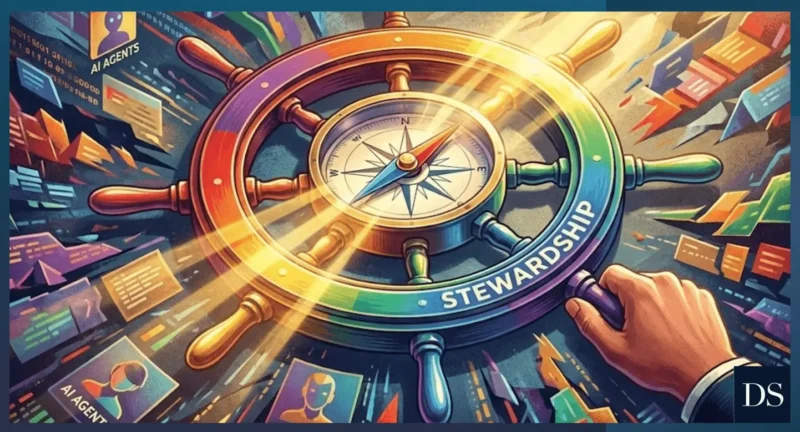
Conclusion: the leadership shift from adoption to stewardship
If 2024 was the year of experimentation, 2025 was the year the industry learned two truths at once:
- AI systems are now capable enough to act inside workflows.
- Many organizations still struggle to translate that capability into durable, measurable value.
That tension defines 2026.
So the leadership role changes. The winning move is not to “buy more AI.” It is to become a steward of organizational intelligence:
- Decide where agency is permitted.
- Redesign workflows around hybrid labor.
- Engineer governance as part of the stack.
- Measure outcomes, not excitement.
The future will not belong to the companies with the most AI.
It will belong to the companies with the clearest operating model for AI.