

Opinion: Optimization is a necessary school, but a fatal destination. How we navigated the four traps of the AI era to reinvent our soul.
By Said Oualibouch December 6, 2025
Editor’s Note: The following article is a work of “Future History”, a fictional scenario set five years in the future. It illustrates the trajectory of a legacy organization that successfully navigated the “Great AI Filter” by recognizing that AI is not just a technology, but a catalyst for cultural rebirth.
The Architecture of Survival
December 15, 2030.
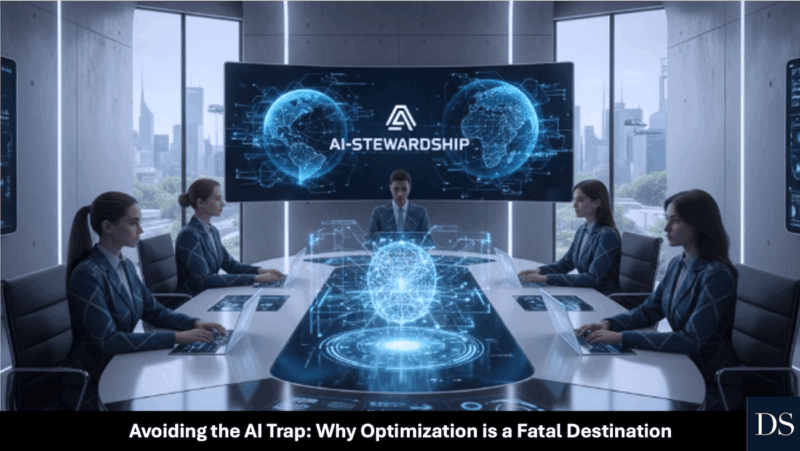
The light in the boardroom is different today. It is the light of a new dawn. The President of the Board stands at the smart-glass window, looking down at a city that functions like a living organism, autonomous, fluid, and hyper-efficient. Inside the room, the atmosphere is no longer one of relief; it is one of electric vitality. We are not just a company that survived the “AI Purge” of the late 2020s. We are a company that was reborn.
On the table lies a holographic projection of our stock performance over the last decade. It traces a perfect “J-Curve”: a slow, agonizing drop that steepened sharply early 2025, followed by a vertical ascent that began in late 2026.
“Do you remember the bottom of that curve?” the President asks, turning to the room.
We all nod. We remember. That was the moment we realized we were navigating a minefield. That was the moment we identified the Four Traps that were killing our competitors, and almost killed us.
The Anatomy of the Fall (2024-2025)
Let’s be honest about where we were in 2025. We were a textbook case of what organizational theorist Dr. Ichak Adizes calls the “Stability” phase. We were profitable, organized, and well-dressed. But we were sliding toward Aristocracy.
Our CFO was a magician, using every financial lever to maintain profitability despite flattening sales. But the rot was invisible. We were suffering from “Success Trauma.”
When the AI wave crashed over us, we looked around at the market and saw our peers falling into specific, fatal errors. To survive, we had to navigate four distinct existential risks.
Trap 1: The Trap of Inertia (“The Wait-and-See Approach”) – Many of our competitors chose to “do nothing.” They treated AI as hype. They waited for regulatory clarity or for the technology to “stabilize.” They called it “prudence.” The market called it obsolescence. By the time they decided to move in 2027, the gap in data acquisition and institutional learning was unbridgeable. They didn’t fail; they simply faded away.
Trap 2: The Trap of Technocentrism (“AI as an IT Project”) – We almost fell here. Initially, we delegated AI to the CIO. We treated it as a technology stack, buying licenses, setting up servers, hiring Python developers and data scientists. But we quickly realized that AI as a technology, divorced from strategy, is a failure. We had “Pilots” everywhere, but no value anywhere. We were building sophisticated engines for a car that was driving off a cliff. We learned the hard way: AI does not fix a broken business model; it accelerates it.
The Pivot: The Optimization Paradox
This brings us to the most seductive trap of all.
Trap 3: The Optimization Mirage – In 2025, under immense pressure to show returns, we fell into the “So-So Automation” trap identified by economists Acemoglu and Restrepo.
We used AI to cut costs. We optimized supply chains. We automzed order handling. We deployed chatbots to deflect calls. And it worked. We became faster. We became cheaper. Our EBITDA improved for two quarters.
But our AI Steward, the external guardian we hired to save us from ourselves, sat us down and delivered a hard truth:
“Optimization is a drug. It feels like progress, but it is just a delay of execution.If your only aim is to reduce costs, you are just building a faster Titanic.”
However, this is where our story diverged from the failures. We didn’t abandon optimization. We reframed it. We realized that Optimization was not the destination; it was the tuition fee. We used the efficiency phase to clean our data, build organizational muscle, and fund the real journey.
The Final Hurdle: The Transformation Imperative
Trap 4: The “Bolt-On” Fallacy – The final trap was believing we could just “add” AI to our existing company without changing our soul. We realized that adopting AI without making it a pillar of a Holistic Transformation is the most subtle trap of all.
Under the guidance of our Steward, we initiated the “Reimagination Protocol.”
1. From Reselling to Radical Intimacy We realized we were flying blind. We sold through resellers and didn’t know our end customers. We rearchitected our connection to our customers, and used AI to leverage this direct digital bridge. We ingested market signals, sentiment, and usage patterns. We didn’t just analyze data; we synthesized empathy. We moved from selling “Drills” to selling “Holes.” We moved from selling “Units” to selling “Outcomes.”
2. From “Manager” to “Coach” We redesigned our Human Capital. In 2025, our people were the “immune system” attacking the AI. They feared job loss. We changed the contract. We stopped hiring for “Skills” (which expire) and started hiring for “Agility” (which endures). We abolished the role of the “Manager” who controls tasks (AI does that now). We created the role of the “Coach” who unlocks Human-AI potential.
2030: Beyond the Algorithm (The Cultural Moat)
This brings us to the present moment. And here lies the most important lesson for any Board Member reading this file. Our technology is advanced, yes. We have mature World Models, Cognitive, and Self-Organizing Agentic Workflows, and Self-Healing Supply Chains. But our competitors have access to the same technology. The algorithms are a commodity. The reason we are thriving. The reason we are the “Phoenix” is not our AI. It is our Culture of Continuous Self-Renewal. We leveraged AI strategically, but we’ve simultaneously built a culture that is Antifragile.
The Democratization of Innovation
In the old days, innovation was a department. It was a silo. Today, innovation is oxygen. Because we used AI to automate the drudgery (the “Administration”), we liberated the cognitive surplus of 15,000 employees. We have “Innovation Squads”, cross-functional teams of junior staff and senior experts, who use AI to hack their own workflows and invent new service lines. We don’t punish failure; we treat it as data generation. The “Wild Ducks” came back. The entrepreneurs who left us in 2024 returned because we became the best place in the world to build the future.
Strategic “Aigility” (AI + Agility)
We moved beyond “Agile Software Development” to “Organizational Agility.” In the past, we did 5-year strategic plans that were obsolete by the time the ink dried. Now, we operate in dynamic sprints. Our AI systems simulate millions of market scenarios nightly, but our people have the agility to pivot the entire organization based on those insights. We are no longer a supertanker that takes miles to turn. We are a murmuration of starlings, thousands of independent and collaborating agents moving in perfect synchronization.
The Discipline of Self-Renewal
We solved the “Innovator’s Dilemma.” Most companies die because they protect their cash cow until it starves. We built a culture that is willing to cannibalize itself to survive. We use AI to identify which parts of our business show symptoms of decline (the “Stability” trap) and we ruthlessly prune them to feed the new growth (the “Prime” state). We are not static. We are a river. We change our banks to control the flow.
The Guardian’s Verdict
As I look around this table in 2030, I see the faces of leaders who had the courage to admit that their old map didn’t fit the new territory.
To the Leader reading this in 2026, hear this warning:
You are navigating a landscape of traps. Inaction is a death sentence. Tech-first is a waste of capital. Optimization is a necessary school, but a fatal destination. But the greatest truth is this:
AI is just a tool. It is a powerful engine, but it is cold. Your Culture is the steering wheel. Your Vision is the fuel.
If you implement AI without transforming your culture, your business, you will just run off the cliff faster. But if you use AI to liberate your human capital, to foster a culture of radical agility and continuous renewal… then you become unstoppable.
Don’t just optimize the past. Invent the future.