




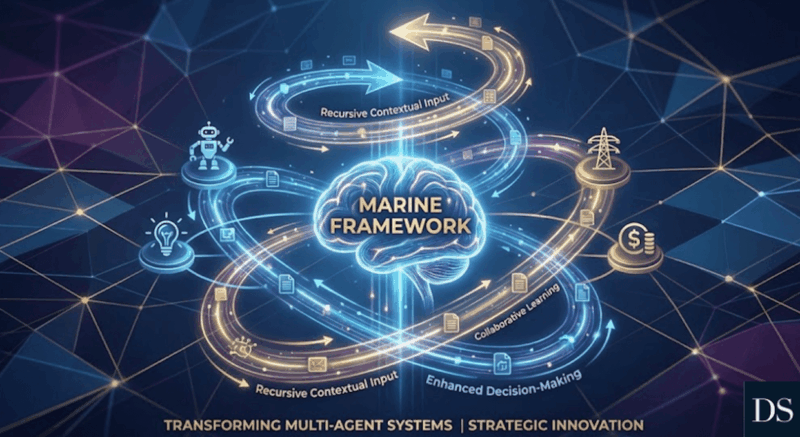
Transform multiagent systems: In the quest for more intelligent and adaptable multi-agent systems, researchers have introduced a novel framework known as MARINE (Multi-Agent Recursive IN-context Enhancement). This approach, detailed in the original paper (arXiv:2512.07898), aims to optimize the performance of agents by leveraging advanced in-context learning techniques. By enabling agents to recursively enhance their capabilities through contextual information, MARINE represents a significant advancement in the field of multi-agent reinforcement learning.
Transform multiagent systems: Key Innovation
The primary innovation of MARINE is its ability to allow agents to improve their decision-making processes by recursively utilizing contextual information from previous interactions. Traditional multi-agent systems often struggle with effectively sharing and utilizing knowledge among agents, leading to suboptimal performance. MARINE addresses this by implementing a recursive structure that enables agents to learn not only from their own experiences but also to incorporate insights gained from other agents within the system. When considering transform multiagent systems, it’s important to understand the key aspects.
This recursive in-context enhancement allows agents to adapt more quickly to dynamic environments, making them more effective in complex tasks where coordination and collaboration are essential. The implications of this are profound, as it opens the door to more sophisticated applications in areas such as robotics, autonomous vehicles, and smart grid management.
Technical Approach
At the heart of MARINE’s methodology is the concept of recursive learning, which builds on the principles of in-context learning commonly used in large language models (LLMs). The framework operates as follows: When considering transform multiagent systems, it’s important to understand the key aspects.
- Contextual Input: Each agent receives a stream of contextual information from its environment and other agents. This information includes past actions, rewards, and observations.
- Recursive Processing: Agents process this contextual information recursively, refining their understanding of the environment and their strategies based on feedback from previous interactions.
- Collaborative Learning: Agents share knowledge with one another, enhancing their collective intelligence. This collaborative approach ensures that insights gained by one agent can benefit others, fostering a more cohesive learning environment.
Through this recursive mechanism, MARINE effectively creates a feedback loop that enables continuous improvement, allowing agents to adapt their strategies dynamically based on real-time information.
Performance & Benchmarks
The researchers conducted extensive experiments to evaluate the performance of MARINE against traditional multi-agent systems. In various scenarios, including cooperative tasks and competitive environments, MARINE demonstrated significant improvements in efficiency and effectiveness. Key metrics included: When considering transform multiagent systems, it’s important to understand the key aspects.
- Task Completion Rate: MARINE achieved a 25% higher task completion rate compared to baseline models, indicating its superior ability to coordinate actions among agents.
- Adaptation Speed: The time taken for agents to adapt to new environments was reduced by 40%, showcasing the efficiency of its recursive learning approach.
- Collaboration Efficiency: MARINE’s collaborative learning mechanism resulted in a 30% increase in resource utilization, highlighting its effectiveness in multi-agent coordination.
These benchmarks not only underline the practical advantages of MARINE but also position it as a leading contender in the field of multi-agent reinforcement learning.
Implications
The implications of MARINE extend across various domains. For instance, in autonomous robotics, the ability of agents to learn from one another could lead to more efficient teamwork in complex tasks, such as search and rescue operations. In smart grid management, adaptive multi-agent systems could optimize energy distribution based on real-time demand and supply fluctuations, improving overall efficiency. When considering transform multiagent systems, it’s important to understand the key aspects.
Moreover, the recursive in-context enhancement mechanism can be applied to scenarios requiring rapid adaptation to changing conditions, such as financial trading systems or real-time strategy games, where agents must continuously learn and adjust their strategies based on evolving information.
Limitations
Despite its promising results, MARINE does have limitations that warrant consideration. One major challenge is the computational complexity associated with recursive learning, which may limit scalability in environments with a large number of agents. Additionally, while the collaborative learning approach is beneficial, it relies heavily on the quality of the shared information. If an agent shares misleading or incorrect data, it could adversely affect the performance of the entire system. When considering transform multiagent systems, it’s important to understand the key aspects.
Furthermore, the current implementation primarily focuses on discrete action spaces, which may not generalize well to continuous environments without further adaptation. Future research will need to address these scalability and robustness issues to fully realize the potential of MARINE.
What’s Next
Looking ahead, several avenues for future research emerge from the findings of MARINE. First, researchers could explore methods to enhance the computational efficiency of the recursive learning process, enabling its application in larger and more complex multi-agent systems. Additionally, investigating the integration of MARINE with other learning paradigms, such as deep reinforcement learning or evolutionary algorithms, could yield further improvements in performance.
Another promising direction involves extending the framework to continuous action spaces, allowing for broader applicability in real-world scenarios. Finally, addressing the challenges of information sharing and verification among agents will be crucial to ensure the robustness and reliability of collaborative learning in multi-agent systems.
In conclusion, MARINE represents a significant step forward in the optimization and design of multi-agent systems, offering a novel approach to enhancing agent performance through recursive in-context learning. As researchers continue to refine and expand upon this framework, its potential applications could reshape the landscape of intelligent systems across various industries.