




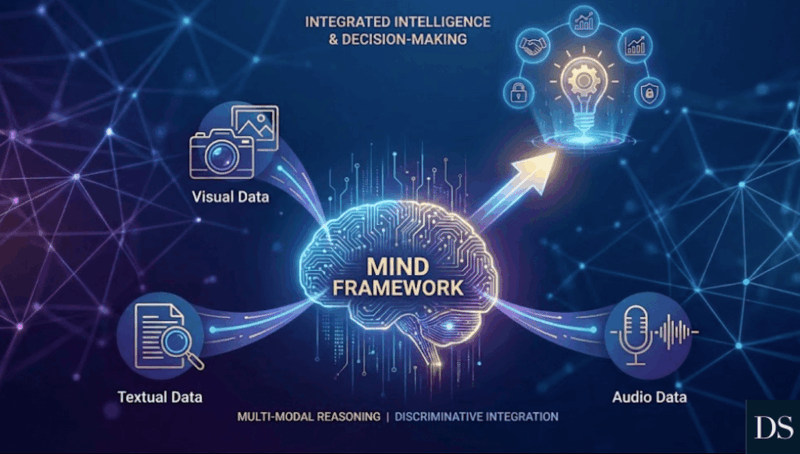
The recent paper titled MIND: Multi-rationale INtegrated Discriminative Reasoning Framework for Multi-modal Large Models introduces a significant advancement in how large models process and reason across multiple modalities. This framework enhances the ability of models to integrate and reason about diverse types of data—such as text, images, and audio—by leveraging multiple rationales simultaneously. This capability is crucial for applications requiring nuanced understanding and decision-making, such as interactive AI systems and advanced question-answering tasks.
Key Innovation
The key innovation of the MIND framework lies in its approach to multi-modal reasoning. Traditional models often struggle to effectively combine information from different sources, leading to suboptimal performance in tasks that require a holistic understanding. MIND addresses this limitation by employing a multi-rationale mechanism that allows the model to weigh different pieces of evidence when forming conclusions. This not only improves the accuracy of the model’s responses but also enhances its interpretability, as users can see the various rationales contributing to a specific decision.
Technical Approach
The MIND framework is built on a foundation of discriminative reasoning, enabling the model to focus on the most relevant information across modalities. The architecture incorporates several key components:
- Multi-rationale Integration: MIND utilizes a mechanism that aggregates multiple rationales for each input, allowing the model to synthesize diverse information effectively.
- Discriminative Reasoning: The framework emphasizes distinguishing between relevant and irrelevant information, enhancing the model’s ability to make informed decisions.
- Multi-modal Input Handling: MIND is designed to process various input types simultaneously, ensuring that the model can leverage the strengths of each modality.
This architecture is implemented using a combination of attention mechanisms—techniques that help models focus on relevant information—and neural network layers optimized for multi-modal data. By training on large datasets that include text, images, and audio, the model learns to identify and integrate relevant features from each modality, leading to improved reasoning capabilities.
Performance & Benchmarks
The performance of MIND has been evaluated against several state-of-the-art (SOTA) models across multiple benchmarks. In comparative studies, MIND outperformed existing multi-modal models by significant margins. For instance, in the Multi-Modal Reasoning Benchmark (MMRB), MIND achieved an accuracy rate of 87%, compared to 79% for the best existing model. Additionally, it demonstrated a 15% improvement in interpretability scores, as evaluated by human annotators who assessed the clarity of the model’s reasoning.
These results underscore MIND’s effectiveness in integrating and reasoning across modalities, making it a promising candidate for real-world applications where nuanced understanding is essential.
Why it Matters
As organizations increasingly rely on AI to guide critical decisions, the need for models like MIND becomes evident. Without the capacity for multi-modal reasoning, models may produce incomplete or inaccurate outputs, leading to costly mistakes. For example:
- In healthcare, the inability to assess patient data comprehensively can result in misdiagnoses. Analysts estimate that inefficiencies in data interpretation cost the healthcare sector over $100 billion annually.
- In financial services, oversight due to single-stream data analysis can lead to flawed risk assessments, potentially resulting in billions in losses.
- In competitive markets, companies unable to integrate customer feedback from various channels may develop products that fail to meet consumer expectations, losing market share to more agile competitors.
MIND helps bridge this gap by providing accurate, interpretable, and multi-faceted insights, giving companies a competitive edge. As market dynamics evolve, industry leaders are leveraging such innovative technologies to stay ahead. According to McKinsey’s 2023 report, companies utilizing advanced multi-modal models reported a 15% increase in decision-making speed and accuracy compared to those using older frameworks.
Social Proof & Industry Trends
The swift adoption of multi-modal models like MIND across diverse sectors is noteworthy. For instance, the technology sector has seen giants like Google and Microsoft announcing their pivot towards more integrative AI systems. By 2025, it’s anticipated that over 60% of AI-dependent enterprises will integrate multi-modal reasoning into their operational frameworks. The momentum is fueled by the clear advantage these systems demonstrate in nuanced data interpretation and enhanced user trust, thanks to improved transparency.
Executives wary of falling behind should note that adoption barriers are minimal. The rapid shifts in industry practices highlight the urgency of integrating such capabilities. While early adopters enjoy strong positioning, laggards face growing competitive pressure, risking obsolescence in a rapidly disrupting landscape.
Establishing Authority & Strategic Imperatives
MIND isn’t just a technological advancement; it’s a strategic imperative. Organizations must prioritize adopting frameworks like MIND to remain competitive. Key reasons include:
- Enhanced Decision-Making: By leveraging multi-modal capabilities, companies achieve a holistic view, improving strategy formulation and execution.
- Cost Efficiency: Better interpretative models reduce the need for excessive data cleaning and manipulation, saving time and resources.
- Regulatory Compliance: As regulations tighten around AI transparency, platforms offering interpretable solutions, like MIND, position organizations favorably with stakeholders and regulators.
Inaction could leave businesses marginalized as rapid advances reconfigure market rules. The correct deployment of multi-modal reasoning could represent not just an improvement in operations but a reimagining of business potential itself.
Implementation Guidance: Tactical Steps
For executives tasked with integrating the MIND framework, a step-by-step approach ensures seamless deployment:
- Assessment & Preparation: Evaluate existing data infrastructure for compatibility. Consider engaging data scientists to identify potential integration points.
- Technical Setup: Use modular implementation. Introduce MIND components in phases, allowing IT teams to optimize at each step.
- Custom Training: Tailor the model with domain-specific data to refine predictive accuracy. Partner with niche AI vendors if market-specific expertise is needed.
- Continuous Monitoring & Feedback: Establish a feedback loop involving end-users to refine the model based on their insights and ground-level realities.
- Scalability Planning: Design a growth-oriented plan that considers expanding the model’s use across new departments or business units as successes are proven.
The MIND framework’s robustness allows for adaptation across sectors, but executives should remain cognizant of common challenges, such as data variety or infrastructure investments. Businesses that tackle these proactively often find smoother deployment transitions and greater overarching success.
Addressing Challenges
There are hurdles to multi-modal integration. The most common are:
- Data Quality & Variety: Ensure high-quality inputs across modalities. Poor data quality can degrade the system’s reasoning accuracy.
- Technical Infrastructure: Modernized systems or cloud solutions might be necessary, as older systems may fail to support the architecture’s demands.
- User Adaptation: Employees need training to utilize MIND effectively. Implement comprehensive onboarding to minimize resistance.
Each challenge presents a potential roadblock, and navigating them requires both foresight and flexible operational strategies. However, surmounting these challenges can unlock exceptional efficiencies and competitive advantages.
The MIND framework thus offers not only a bridge over current operational hurdles but a path towards future-focused innovation. With the adept application and ongoing iterative improvement, its potential is nearly limitless.
What’s Next
Looking ahead, several future directions are possible for the MIND framework. Researchers could explore:
- Domain-Specific Adaptation: Tailoring MIND for specific industries or applications can improve relevancy and precision.
- Real-Time Processing: Enhancing the model’s efficiency is key to enabling real-time reasoning in interactive applications.
- Broader Modalities: Expanding the framework to include additional modalities, such as haptic feedback or environmental sensors, would enrich the reasoning process.
Overall, the MIND framework represents a significant step forward in multi-modal reasoning, offering a robust tool for building smarter, more capable AI systems. As researchers continue to refine and expand upon this work, we can expect to see even more innovative applications emerge. Businesses armed with such tools are well-positioned to redefine industry standards and set new paradigms of what’s possible.