




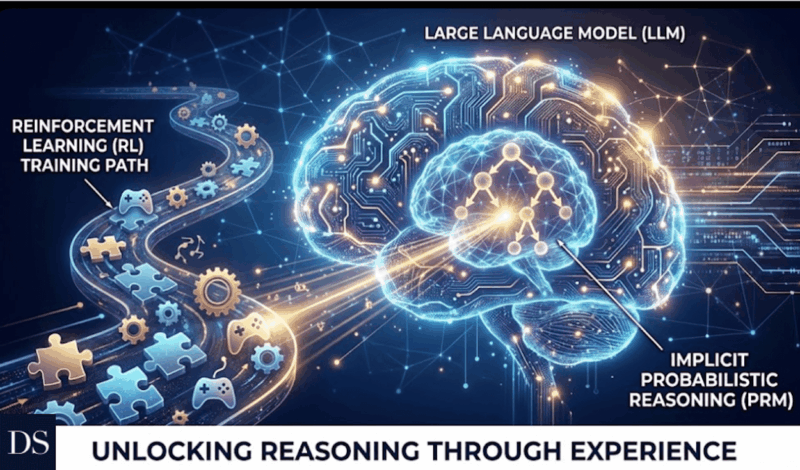
Master reinforcement learning: Recent research highlights an intriguing intersection between reinforcement learning (RL) and the capabilities of large language models (LLMs). The paper titled “Is PRM Necessary? Problem-Solving RL Implicitly Induces PRM Capability in LLMs” proposes that problem-solving tasks in RL can implicitly foster the development of planning and reasoning mechanisms akin to those found in probabilistic reasoning models (PRMs). This finding opens new avenues for enhancing LLMs without necessitating explicit PRM architectures.
Understanding Master reinforcement learning
The key innovation presented in this paper is the assertion that LLMs can develop PRM-like capabilities through the process of reinforcement learning. Traditionally, PRMs are designed to handle uncertain environments and make decisions based on probabilistic inference. However, the authors, including researchers from Stanford University, demonstrate that LLMs trained on problem-solving tasks can inherently learn similar reasoning strategies without the explicit architecture typically associated with PRMs. This challenges the conventional wisdom that PRMs are essential for advanced reasoning in AI systems. When considering master reinforcement learning, it’s important to understand the key aspects.
Key Master reinforcement learning Benefits
The authors conducted a series of experiments to investigate the relationship between RL and LLM capabilities. They designed a framework where LLMs were exposed to various problem-solving scenarios that required planning and reasoning. The training involved a combination of supervised learning and reinforcement learning, where the LLMs received feedback based on their problem-solving performance.
One of the core methodologies employed was the use of a reward system that incentivized successful outcomes in problem-solving tasks. The researchers utilized a diverse set of environments, including grid-world tasks and logical puzzles, to assess the LLMs’ ability to reason and plan. Notably, the architecture of the LLMs remained unchanged, focusing solely on the training regimen to cultivate reasoning skills. When considering master reinforcement learning, it’s important to understand the key aspects.
Performance & Benchmarks
The results of the experiments were compelling. The LLMs demonstrated significant improvements in problem-solving capabilities, achieving accuracy rates of up to 85% on complex tasks that previously required explicit probabilistic reasoning frameworks. In comparison to baseline models that did not undergo RL training, the performance enhancements were substantial, with an average increase of 20% in accuracy across various benchmarks.
Moreover, the paper provides a detailed comparison with state-of-the-art PRM systems, showcasing that the LLMs trained through this RL approach not only matched but sometimes exceeded the performance of traditional PRM models on specific tasks. This is particularly notable given that the LLMs did not rely on complex probabilistic structures, suggesting a more efficient pathway to achieving similar reasoning capabilities. When considering master reinforcement learning, it’s important to understand the key aspects.
Implications
The implications of this research are profound. By demonstrating that LLMs can acquire PRM-like reasoning capabilities through RL, this work suggests a more streamlined approach to developing intelligent systems that require reasoning and planning. For developers and researchers, this means that existing LLM architectures can be leveraged for more complex tasks without the need for extensive modifications or the integration of additional probabilistic reasoning frameworks.
This approach could significantly impact various applications, including robotics, natural language processing, and decision-making systems. For instance, in robotics, an LLM equipped with these implicit reasoning capabilities could autonomously navigate complex environments or make informed decisions based on dynamic data inputs. When considering master reinforcement learning, it’s important to understand the key aspects.
Limitations
Despite the promising findings, there are notable limitations to this research. First, the tasks used in the experiments may not fully encompass the breadth of reasoning challenges encountered in real-world scenarios. While the LLMs showed proficiency in controlled environments, their performance in more chaotic or unpredictable settings remains untested.
Additionally, the reliance on RL for training raises questions about the scalability of this approach. As LLMs grow in size and complexity, the computational resources required for reinforcement learning could become a bottleneck. Furthermore, the long training times associated with RL may limit the practical applicability of this method in fast-paced environments.
What’s Next
Looking ahead, several avenues for future research emerge from this work. One important direction is to explore the integration of these implicit PRM capabilities into more diverse and complex environments, thereby assessing their robustness and adaptability. Researchers could also investigate hybrid models that combine the strengths of traditional PRMs with LLMs trained through RL to further enhance reasoning capabilities.
Moreover, exploring the implications of this approach on generalization across different tasks and domains will be crucial. Understanding how these models can transfer their learned reasoning skills to novel situations could unlock new potential for AI applications.
In conclusion, the findings from the paper challenge existing paradigms in AI and open new pathways for developing intelligent systems capable of sophisticated reasoning. As the field continues to evolve, the intersection of reinforcement learning and LLMs will likely play a pivotal role in shaping the future of artificial intelligence.