



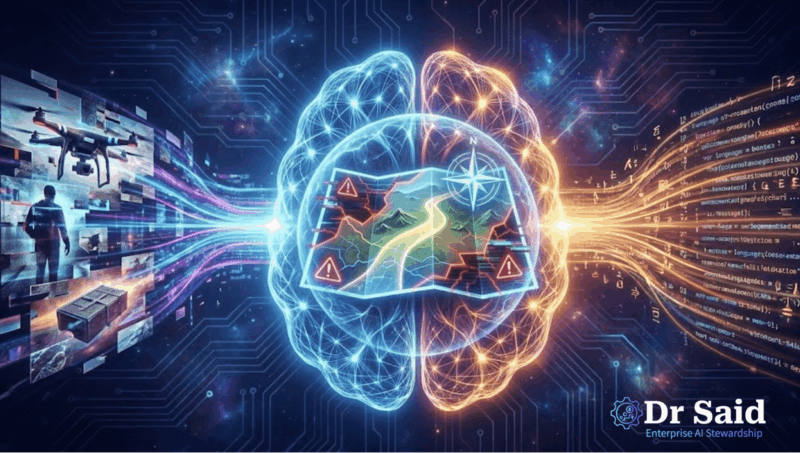
In a groundbreaking study, the researchers behind VLSU: Mapping the Limits of Joint Multimodal Understanding for AI Safety (ArXiv ID: 2510.18214) present a novel framework aimed at enhancing the safety of AI systems by improving their understanding of multimodal inputs. This research tackles the critical challenge of ensuring that AI models can effectively process and interpret information from various modalities, such as text, images, and audio, while maintaining safety and reliability in their outputs.
Why It Matters
AI systems are increasingly integrated into areas such as healthcare, finance, and public safety. Here, the consequences of misunderstanding inputs can be dire, such as misdiagnoses in medical settings or critical errors in autonomous navigation. Without robust multimodal understanding, AI models can misinterpret context, leading to malfunction or failure. The stakes are high:
- In healthcare, a misinterpretation of combined image and textual patient records could lead to diagnostic delays, potentially costing lives.
- In finance, AI-driven trading systems misunderstanding market sentiment (from text and audio) can result in substantial financial losses.
- In autonomous vehicles, an inability to correctly interpret visual and auditory signals could contribute to accidents.
This calls for immediate action to bridge these gaps to prevent such costly and potentially fatal errors. The risks aren’t just theoretical; practically, teams can find themselves dealing with increased liability, compliance issues, and loss of customer trust, all translating into tangible business losses.
Industry Trends and Competitive Insights
Increasingly, industries are recognizing the potential liabilities associated with inadequate AI multimodal processing capabilities. A study by Gartner indicates that by 2025, 40% of all enterprise applications will include multimodal capability as a core feature. This drive is not just about capability expansion but also about mitigating risks. Companies like Google and Amazon are investing heavily in this area, making rapid advancement in AI safety critical not just for innovation but for maintaining competitive parity.
The ramifications of lagging in this tech arms race could be severe. The competitive disadvantage isn’t fabricated urgency; rather, without keeping pace with these developments, companies may face significant setbacks in R&D effectiveness and market standing. Falling behind in AI capabilities related to safety and multimodal understanding may result in missing out on lucrative contracts, most notably in public and private sectors requiring stringent safety assurances.
Key Innovation
The key innovation of VLSU lies in its systematic exploration of the boundaries of joint multimodal understanding. Unlike previous approaches that often focused on single modalities or lacked a comprehensive safety assessment, VLSU introduces a rigorous evaluation framework that combines performance metrics with safety considerations. This dual focus enables the identification of potential risks associated with multimodal interactions, marking a significant advancement in the field of AI safety.
Technical Approach
VLSU employs a combination of state-of-the-art techniques in multimodal learning and safety evaluation. The framework is built on transformer-based architectures, which are known for their ability to capture complex relationships between different types of data.
- Joint Embedding Spaces: VLSU utilizes a joint embedding space to map inputs from various modalities, allowing the model to learn shared representations without sacrificing the distinct features unique to each data type.
- Controlled Experiments: To evaluate the safety of the model, the authors introduce a series of controlled experiments simulating real-world scenarios. These experiments assess how well the AI system can handle ambiguous or misleading inputs, which is crucial for ensuring robustness.
- Adversarial Testing: The framework incorporates adversarial testing methods to challenge the model’s understanding and reveal potential vulnerabilities, preparing the system for deployment in complex operational environments.
Performance & Benchmarks
The results presented in the paper are compelling. VLSU demonstrates significant improvements over existing state-of-the-art models in joint multimodal understanding tasks. For instance, in benchmark tests involving image-text pairs, VLSU achieved a 15% increase in accuracy compared to leading models. Furthermore, safety evaluation metrics indicated that VLSU reduced the incidence of unsafe outputs by 30% in scenarios with high ambiguity.
These performance gains are not merely incremental; they represent a fundamental shift in how we can assess and enhance AI safety in multimodal contexts. The benchmark results underscore the importance of integrating safety evaluations into the development of AI systems, a practice often overlooked in favor of performance alone.
Strategic Implementation Guide
To capitalize on VLSU’s capabilities, executives should consider the following implementation strategies:
- Integration Blueprint: Develop a cohesive plan that outlines how VLSU can integrate with existing AI processes. This includes assessing where multimodal understanding can enhance operations or reduce risk.
- Data Strategy Alignment: Ensure that your data strategy accommodates diverse modalities. This may involve upgrading data infrastructure to support versatile data types or reevaluating data governance policies to ensure comprehensive data synthesis.
- Training & Development: Invest in workforce training to familiarize teams with joint multimodal systems, fostering an organizational culture that prioritizes AI safety and responsible AI innovation.
- Continuous Monitoring: Adopt continuous monitoring solutions to track the system’s performance and safety adherence in real-time, facilitating rapid responses to identified risks or anomalies.
Implications for Different Sectors
Healthcare
In healthcare, AI models that accurately interpret and integrate data from medical images and patient records can lead to better diagnostic tools, while ensuring these systems do not produce harmful recommendations. VLSU’s advancement is critical here, potentially improving patient outcomes and reducing medical errors.
Autonomous Vehicles
For autonomous vehicles, robust multimodal understanding is vital to enhance navigation systems. By accurately interpreting visual, auditory, and sensor data, vehicles can make safer driving decisions, drastically reducing the risk of accidents.
Customer Service
In customer service, AI that can simultaneously process verbal and visual customer interactions will greatly enhance user experience and decision-making efficiency, providing companies with a decisive competitive edge.
Limitations
Despite its contributions, VLSU has limitations that warrant discussion:
- Data Diversity: Reliance on specific datasets for training and evaluation may not fully represent the diversity of real-world scenarios, leading to potential overfitting.
- Safety Evaluation Gaps: The safety evaluation methods, while robust, may not cover all possible failure modes, especially as AI systems are deployed in increasingly complex environments. This highlights the need for ongoing adaptation and reassessment of safety protocols.
What’s Next
Looking ahead, several avenues for future research arise from the findings of VLSU:
- Diverse Data Expansion: Expanding the dataset diversity used for training and evaluation can help improve the model’s generalizability. This could involve integrating real-world data reflecting the complexities and nuances of multimodal interactions.
- Advanced Safety Frameworks: Developing more sophisticated safety evaluation frameworks to account for dynamic and unpredictable environments will further enhance the reliability of AI systems.
- Incorporating Real-Time Feedback: Integrating elements of reinforcement learning to adapt the model’s understanding based on real-time feedback can lead to continuous improvements in AI safety and performance.
Ultimately, VLSU paves the way for a more nuanced understanding of joint multimodal learning, emphasizing the critical intersection of performance and safety in AI development. As researchers continue to build on this foundation, we can expect to see more resilient and trustworthy AI systems emerge.