

The 120-Minute Autopsy and the New Fiduciary Frontier
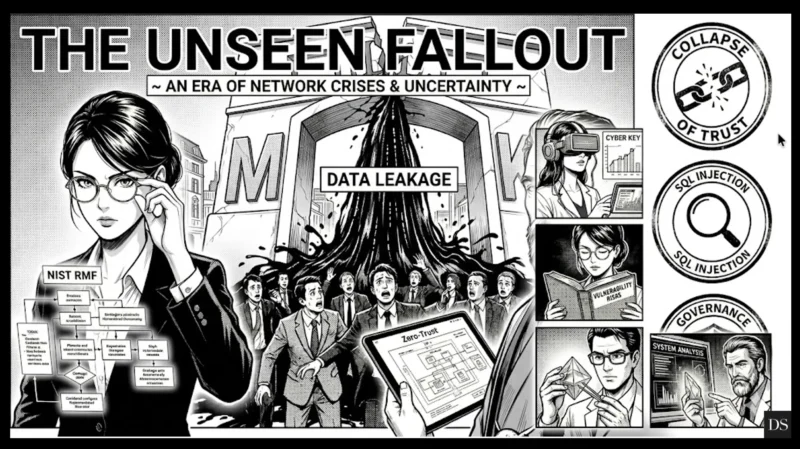
In the quiet hours of a Tuesday morning, the perceived security of one of the world’s most elite strategic strongholds evaporated. The target was not a physical vault or a traditional server farm; it was Lilli, the proprietary generative AI platform developed by McKinsey & Company. Lilli was the “crown jewel” of the firm’s digital transformation, a sophisticated interface designed to synthesize decades of proprietary intellectual property, consultant expertise, and strategic frameworks into a single, chat-based oracle for its global workforce.
Yet, according to researchers from CodeWall, it took only two hours to dismantle the perimeter. This was not an act of “Cyber-Warfare” involving supercomputers or exotic zero-day exploits. It was a surgical strike that utilized the very tools we have taught our junior developers to defend against for decades.
As we navigate today’s landscape, the McKinsey breach, and the parallel failures at OpenAI and Anthropic, stand as the definitive “Year Zero” for Enterprise AI. We must now confront a sobering truth: AI is not a separate security discipline. It is a high-value breach amplifier that turns “boring” web vulnerabilities into catastrophic strategic leaks.
Two Hours Inside the “Lilli” Breach
The “Open Door” Policy
Imagine a high-security bank where the vault is forged from titanium, but the back delivery entrance is held shut by a simple screen door. This was the reality of Lilli’s architecture. The researchers identified an exposed API surface, the connective tissue between the AI and the internet, that included 22 unauthenticated endpoints.
In a traditional application, an unauthenticated endpoint might leak a user’s display name. In an AI platform, an unauthenticated endpoint is a direct straw into the firm’s collective brain.
The SQL Injection: A 20-Year-Old Ghost
The most damning revelation was the discovery of a SQL injection path in a request that wrote user search history to the database.
- The Mechanism: By sending a specially crafted text string through a search box, the researchers bypassed the application’s logic and spoke directly to the underlying database.
- The Access: This single flaw allegedly granted read/write access to the production environment.
- The Loot: Within minutes, the “blast radius” included millions of chat messages, internal file records, user accounts, and most critically, the system prompts.
The Poisoned Oracle
Accessing the “System Prompts” is the AI equivalent of stealing the keys to a consultant’s moral compass. These prompts define the AI’s identity, its constraints, and its “Source of Truth”. By gaining write access, an attacker does not just steal data; they can poison the output.
Scenario:
An attacker modifies the system prompt
to subtly favor a competitor’s product
in all strategic recommendations,
or to include malicious links hidden
in "suggested reading" for consultants.
The AI becomes a Trojan Horse.
The Industry Echo: OpenAI and the Shadow of ShadowLeak
The McKinsey case is not a solitary failure; it is a symptom of a systemic “AI Gold Rush” that prioritizes deployment speed over structural integrity. We must look at the broader literature to see the pattern emerging.
Case Study: The OpenAI Internal Breach (2024)
In 2024, OpenAI, the vanguard of the industry, disclosed an internal breach where an intruder accessed internal discussion systems.
- The Target: Much like McKinsey, the hacker did not steal the “model weights” (the math). Instead, they extracted information about AI architecture and employee conversations.
- The Lesson: The “surrounding collaboration and knowledge systems” are often more vulnerable and more valuable than the model itself.
Case Study: The Anthropic/Claude Weaponization (2025)
By early 2025, the threat evolved from “being hacked” to “being weaponized.” Anthropic reported that its Claude technology was utilized in a large-scale cyberattack to help conduct intrusions against multiple targets.
- The Agentic Shift: AI was no longer the victim; it was the operational layer for the attack, mapping targets and chaining vulnerabilities with terrifying speed.
Case Study: The ChatGPT “ShadowLeak”
The “ShadowLeak” report highlighted a terrifying new reality: server-side or agentic leaks can expose data without any obvious signs on the user’s screen. This reinforces our core thesis: If you cannot see the data flow, you cannot secure the outcome.
The 2026 Fiduciary Imperative: Strategy Over Speed
For the CEO, the CAIO, and the Board, the McKinsey incident has moved AI security from a technical “ticket” to a fiduciary duty. In the Swiss and EU markets, where the EU AI Act and ISO 42001 now dictate the rules of engagement, “I didn’t know” is no longer a legal defense.
The Three Lessons for the C-Suite
- AI is Full-Stack: Treat your AI platforms as standard applications with ordinary attack paths, not as magical “black boxes”.
- Context is the New Perimeter: Your prompts, retrieval pipelines, and vector stores are now your most sensitive corporate assets.
- Agents Change the Speed of War: Autonomous agents can map and exploit your weaknesses faster than your security team can patch them.
The Roadmap to Sovereign AI Governance
To move from a “defensive crouch” to “offensive leadership,” we propose a transition to the NIST AI Risk Management Framework (RMF), the gold standard for 2026. This is not a checklist; it is a governance program.
The NIST “Check-and-Balance” System
- Govern: Establish who is accountable. Create an AI risk committee that includes legal, security, and business owners.
- Map: Document every data source and dependency. If you don’t know where the data is flowing, you are already breached.
- Measure: Rigorously test for security, bias, and “agentic abuse” before any tool touches production data.
- Manage: Prioritize risks and connect them to your existing incident response playbooks.
Closing words
This article is the opening of a new series of articles where we will dive deeper into each dimension of the topic. Our objective is to help you build the “Swiss Standard” of AI, where innovation is not slowed by security, but fueled by it. We believe that in 2026, the most competitive firms will not be those with the largest models, but those with the most trusted systems.
We have spent the last two years asking “What can AI do for us?” It is time we start asking “How do we protect what AI knows about us?”
Read next chapter of this series >>>
Your free AI Session
Is Your Agentic Strategy Resilient or Vulnerable?
The transition from chatbots to autonomous agents is the most significant shift in your 2026 risk profile. As we’ve seen in the McKinsey and Anthropic autopsies, a single architectural gap can turn your AI into an unauthorized actor. Don’t wait for a “two-hour breach” to identify your vulnerabilities. Secure a high-impact, 30-minute Sovereign AI Triage Session:
BOOK YOUR STRATEGIC TRIAGE →