

(and how to Retrofit for the Long Game)
The Executive Abstract: Beyond the AI-“Furniture” Phase
Most established firms are currently trapped in the “AI-Furniture Phase” of technological adoption. Organizations are procuring high-cost AI licenses and use cases (expensive “furniture”) without having poured the concrete for the foundation (the “AI-House”).
This structural mismatch is the primary driver of the AI ROI ZERO effect.
In the rush to be “first,” enterprises have bypassed the essential engineering required to make AI “lasting.” This article provides a diagnostic framework for escaping the vendor-driven hype cycle and engineering a Sovereign AI-House that delivers measurable P&L results.
We examine why the current “Status Quo” is not just inefficient, but a form of hidden capital erosion where architectures are designed for vendor margins rather than client strategy and profit.
DEFINITION: THE AI ROI ZERO Effect:
A systemic phenomenon where capital investment in disconnected
AI 'furniture' fails to translate into P&L equity due to foundational
architectural debt.
The Anatomy of AI ROI ZERO: A Forensic Post-Mortem
The Anatomy of AI ROI ZERO: A Forensic Post-Mortem
The current landscape is littered with the remains of Digital and AI Transformations that burned millions only to stall at the pilot stage. This “Pilot Purgatory” is not a failure of the technology itself, but a failure of architectural orchestration.
1. The Procurement Trap: Buying Tools vs. Building Strategy
Organizations frequently procure tools before they have a strategy, leading to a fragmented ecosystem of “Demo-ware” that cannot scale. This mirrors the “Productivity Paradox” where massive IT spending fails to show up in the bottom line because it isn’t integrated into the core operating model.
2. Vendor-Driven Architecture vs. Sovereign Control
Many current AI strategies are shaped by the “Strategic Partner” rather than the business needs. I have observed architectures designed to serve the vendor’s stock price, where leaders become paralyzed by vendor fear and technical debt.
3. The Capital Write-Off
When these uncoordinated initiatives fail to meet security, compliance, or importantly, expected impact, they result in substantial write-offs and deep board frustration. The common pattern is a lack of independent guidance, leaving the organization overwhelmed by complexity.
The “AI-House” Framework: A Three-Phase Retrofit
Transforming AI from an expense into a tangible asset requires a shift from “renting intelligence” to “owning a capability.” This is an operating model designed to fix stalled initiatives and engineer scalable value.
Phase I: The Foundation (Radical Sovereignty)
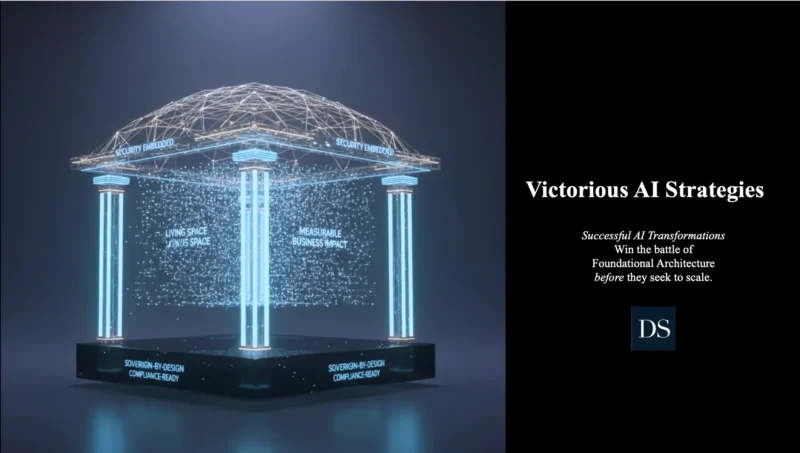
An organization’s intelligence must belong to the organization, not to a tech giant. This follows the “Own, Don’t Rent” philosophy: if you do not hold the keys to your models and data, you preserve no independence or decision-making power. A sovereign architecture preserves data rights and ensures that the “keys” to the house remain in your hands.
Phase II: The Backbone (High-Speed Infrastructure)
Architecture is not a blocker; it is the high-speed infrastructure that allows an organization to transform faster without crashing. By engineering a foundational backbone from the start, we avoid the long-term AI debt created by “Demo-ware.” This backbone ensures that your AI-portfolio remains strictly focused on what is strategically sound and operationally valuable.
Phase III: The Orchestration (P&L Integration)
The final stage of the AI-House is ensuring Board vision translates into measurable results. This requires the “1+1=3” philosophy, where AI multiplies human potential rather than subtracting from it. We shape architectures where experts remain in the loop, amplified by the machine to ensure every Franc invested builds a tangible asset that boosts the P&L forever.
Why “Independent Guidance” is the Missing Variable
In an industry where many advisors and “strategic” partners profit from the tools they recommend, independence is the only counter-weight to the hype cycle. Enterprise AI Stewardship means prioritizing long-term value over short-term excitement.
The Power of Independence:
True stewardship requires a vendor-agnostic approach with no hidden promotions or obligations to tech providers.
A Focus on Integrity:
We refuse to build if it is not ethical, compliant, secure, or adding value; vanity projects have no place in a sound portfolio.
The Role of the Orchestrator:
Moving beyond “Pilot Purgatory” requires a Fractional CAIO or Orchestrator who sits on your side of the table, ensuring that when you build, you build for good.
Conclusion: The Master Builder’s Pledge
In an industry obsessed with “First,” the strategic advantage belongs to those focused on “Lasting.”
Leaders who are tired of the hype must move toward functional and value engineering. Once we align strategy with structural rigor, the impact on the bottom line becomes a predictable outcome rather than a hopeful guess.
Let us stop philosophizing about the future and start engineering the functional foundation your business deserves.
NB: My work is exclusively committed to the ethical deployment of AI.
I do not support projects that think are intended to:
harm society, or
compromise human integrity.