
The gap between visibility and conviction
Artificial intelligence (AI) has become a central feature of corporate strategy. Across industries, companies now present structured roadmaps, defined use cases, and increasingly precise ambitions for how AI will reshape their operations. Investor communications, keynote presentations, and annual reports tend to converge on a common message: the organization understands the trajectory, progress is underway, and the remaining challenge is largely one of execution.
Yet behins this apparent clarity often hides
a more complex internal reality.
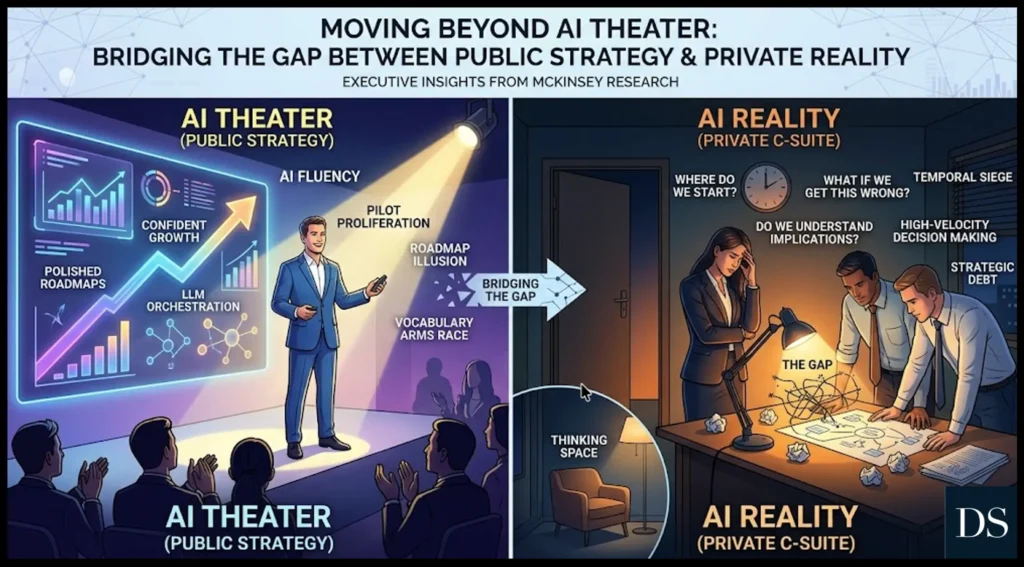
In private discussions, the tone shifts. Conversations become less about scaling what is already known and more about navigating what remains uncertain. Leaders return to more fundamental questions: where to begin in a landscape of competing priorities, how to evaluate risk when the technology itself is still evolving, and how to anticipate second-order effects that extend beyond immediate use cases.
This divergence between public confidence and internal uncertainty is not unusual during periods of technological transition. What is distinctive in the current phase of AI adoption is the extent to which the pace of technological development has compressed the time available for strategic reflection. Organizations are expected to take positions on AI rapidly, often before they have developed a stable understanding of its implications.
The result is a growing gap between
the visibility of strategy
and the depth of conviction behind it.
AI theater as a structural response
One way to understand this gap is through what might be described as “AI theater.” The term is often used critically, suggesting exaggeration or superficiality. But in practice, it reflects a more structural phenomenon.
Organizations are operating under simultaneous pressures: to demonstrate progress, to signal competence, and to maintain alignment across stakeholders. In such conditions, visible structure becomes essential. Roadmaps, pilot programs, and technical narratives provide a shared language that allows the organization to move forward, even when underlying assumptions are still being tested.
Multi-year AI strategies illustrate this dynamic. These plans offer direction and reassurance, but they are developed in a context where the underlying capabilities of the technology evolve on much shorter cycles. As a result, they are frequently revised. Their role is not only to guide execution but also to coordinate expectations in an environment that is inherently unstable.
A similar pattern can be observed in the proliferation of pilot initiatives. Many organizations have launched a wide range of AI projects, such as customer service automation, predictive maintenance, fraud detection, and more. These initiatives generate activity and, in some cases, localized improvements. However, they often remain disconnected from the core operating model. The transition from experimentation to structural integration proves significantly more complex than the initial development of use cases.
In sectors such as telecommunications, this challenge is particularly pronounced. AI initiatives are layered onto existing infrastructures that include legacy systems, vendor dependencies, and strict regulatory requirements. Customer-facing applications, network optimization tools, and analytics platforms may all evolve in parallel, but without a coherent integration strategy, their combined impact remains limited. The difficulty lies not in building AI capabilities, but in embedding them within systems that were not designed for such flexibility.
Alongside these developments, the language of AI has become more prominent in executive communication. Technical terms are increasingly part of strategic discussions, reflecting both genuine engagement and the need to maintain coherence in conversations where certainty is still developing. In this context, language plays a stabilizing role, even when understanding is still partial.
Taken together, these dynamics create a situation in which progress is both real and, at times, overstated.
The questions that remain unspoken
When attention shifts away from formal presentations, a different layer of decision-making becomes visible. In more discreet settings, executives tend to focus on a narrower set of concerns that remain unresolved.
One of the most immediate is the question of where to begin. The range of potential applications for AI is extensive, and each entry point implies different trade-offs in terms of investment, risk, and organizational change. Choosing a starting point is therefore less a technical decision than a strategic one. A focus on narrowly defined use cases may deliver quick results but limit long-term transformation, while more ambitious initiatives introduce greater uncertainty.
A second concern relates to the consequences of failure. AI systems, particularly those based on generative models, introduce forms of unpredictability that differ from previous technological shifts. Outputs may be difficult to fully verify, and errors can have reputational or regulatory implications. As a result, leaders must balance the pressure to adopt quickly with the need to maintain control over outcomes.
A third issue is more structural and extends beyond immediate implementation. AI affects not only efficiency but also the way organizations develop expertise. As certain tasks are automated, the processes through which individuals acquire experience may change. This raises longer-term questions about capability development: if routine work is reduced, how will future expertise be built?
These concerns are not always articulated
in formal strategy discussions,
but they shape decisions nonetheless.
The deciding–thinking gap
At the center of these dynamics lies a tension between the pace of decision-making and the pace of understanding. Leaders are expected to define positions on AI within relatively short timeframes, often in response to external expectations. At the same time, developing a robust understanding of the implications requires sustained analysis, experimentation, and iteration.
This creates a gap between deciding and thinking.
When decisions are made before underlying assumptions have been sufficiently examined, organizations begin to accumulate constraints that are not immediately visible. These constraints can be understood as a form of strategic debt. Unlike technical debt, which is typically observable in systems and code, strategic debt is embedded in choices related to architecture, data governance, operating models, and talent development. In the short term, these decisions may appear effective.
Over time, however, they can limit adaptability,
and increase the cost of change.
Why the gap persists
One reason this gap persists is that many organizations lack environments in which these issues can be explored openly. Executive discussions are often shaped by the need to maintain alignment and confidence. Expressing uncertainty may be interpreted as a lack of direction, particularly in highly visible settings. As a result, certain questions remain underexamined, not because they are unimportant, but because they are difficult to address within existing formats.
In practice, more substantive exploration tends to occur in settings that differ from standard decision-making forums. In these contexts, the emphasis shifts from presenting conclusions to examining assumptions. The conversation becomes less about signaling progress and more about understanding implications.
From activity to decision architecture
The transition from AI theater to more substantive integration does not necessarily require a greater number of initiatives. It requires a shift in how decisions are formed.
This includes clarifying the relationship between experimental projects and core operations, strengthening governance mechanisms, and ensuring that data and architecture choices support long-term objectives. It also involves the ability to formulate precise questions. As the range of possible applications expands, the limiting factor is less the availability of technology than the capacity to identify where it creates meaningful advantage, or exposure.
Data governance illustrates this point. It is often treated as a technical domain, but in the context of AI, it becomes a strategic foundation. Questions of data ownership, lineage, and accountability directly affect the reliability of AI systems and the organization’s ability to manage risk. Without clarity in these areas, scaling AI becomes difficult, and the likelihood of unintended consequences increases.
Organizations that make progress tend to approach these issues
not as isolated technical challenges but
as integral components of their broader strategy.
Conclusion: where real transformation begins
The current phase of AI adoption is characterized by a combination of rapid technological advancement and uneven organizational integration. Public narratives emphasize clarity and momentum, while internal discussions reveal a more complex and evolving reality.
This divergence is not inherently problematic. It reflects the early stages of adapting to a transformative technology. However, it does have consequences. When the pace of decision-making consistently exceeds the pace of understanding, organizations risk building strategies that are difficult to sustain.
Addressing this requires more than technical capability. It requires the capacity to create space for reflection within leadership processes—space in which assumptions can be examined and decisions can be developed with greater precision.
In many cases, the most consequential work does not take place in formal presentations or public announcements. It occurs in more focused settings, where the constraints of visibility are reduced and the emphasis shifts from performance to understanding.
As AI continues to evolve, the ability to manage this balance—between action and reflection, between visibility and depth—will play a central role in determining how effectively organizations translate potential into value.
Free AI Session for Executives
From AI Theater to Impactful AI Reality
For leaders who find that certain AI-related questions are difficult to explore within existing structures, creating a dedicated space for analysis can be valuable. I work with executives in confidential sessions focused on clarifying these questions and structuring decisions accordingly. Book a short call to discuss your AI way forward.
IT’S PRIVATE & CONFIDENTIAL→