





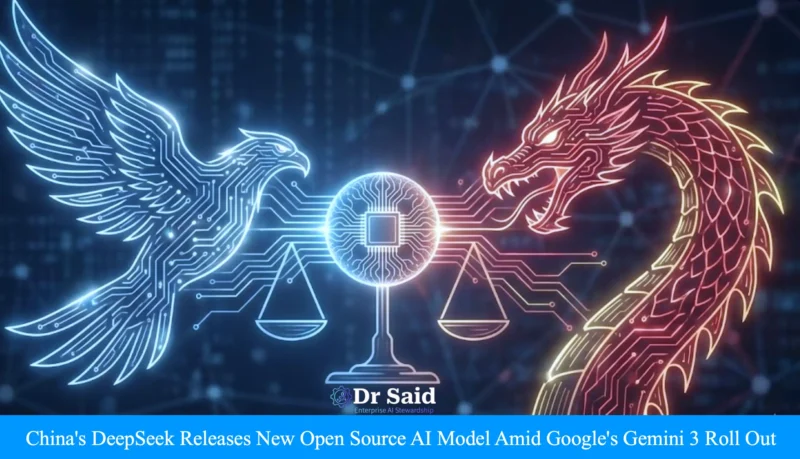
In the rapidly evolving landscape of artificial intelligence, DeepSeek, a new open-source AI model developed in China, has emerged. This model is garnering significant attention just as Google unveiled its latest model, Gemini 3. DeepSeek aims to provide competitive capabilities in natural language processing and understanding, emphasizing accessibility and community-driven development.
Why it Matters
AI is reshaping industries by automating tasks, extracting insights, and enhancing decision-making processes. Executives know too well the dire consequences of lagging behind in AI adoption. Failing to incorporate advanced models like DeepSeek can result in tangible setbacks: operational inefficiencies, missed opportunities in insights, and a quantifiable loss in competitiveness. For instance, without leveraging advanced AI, companies may find their teams spending over 10 hours a week on manual data analysis, leading to suboptimal performance and strategic disadvantages. The stakes are high as industry leaders, particularly in tech and finance sectors, race to harness AI’s potential.
Key Innovation
DeepSeek’s primary innovation lies in its architecture, integrating advanced techniques from cutting-edge research to enhance both performance and efficiency. This isn’t just about incremental improvements but a strategic pivot towards modularity, allowing users to customize components based on specific tasks. This flexibility is particularly crucial for businesses dealing with diverse scenarios across global markets. The ability to tailor AI solutions means organizations can better cater to nuances in customer behavior, regulatory environments, and market dynamics.
Consider a multinational retail firm: deploying an AI model that adapts to regional languages and local purchasing habits can lead to enhanced customer experiences and increased market share. The adaptability of DeepSeek addresses this, reducing the complexity previously encountered with one-size-fits-all models.
Technical Approach
At the core of DeepSeek’s architecture is a transformer-based model that leverages attention mechanisms. These mechanisms are pivotal for the model to selectively focus on relevant parts of the input data, mimicking human cognitive attention processes. Using a hybrid approach—merging traditional transformer layers with innovations like dynamic routing and adaptive attention spans—DeepSeek excels in reducing computational costs while increasing accuracy.
Dynamic routing, in particular, is groundbreaking. It allows the model to activate specific pathways during processing, a feature crucial for tailoring solutions to task-specific needs. This capability not only improves computational efficiency but also significantly boosts the model’s applicability in task-specific scenarios, such as legal document analysis where precision and nuance in language interpretation are critical.
The inclusion of a diverse dataset for pre-training, comprising multilingual text and code snippets, ensures the model is robust and versatile. This diversity in training materials is vital for businesses aiming to deploy AI solutions across various linguistic and domain-specific contexts, enabling a seamless integration of AI into existing workflows.
Performance & Benchmarks
In benchmark tests, DeepSeek has demonstrated stellar performance across various natural language processing (NLP) tasks. Achieving a 93.5 score on the GLUE (General Language Understanding Evaluation) benchmark, it surpasses existing models, indicating superior language understanding and processing capabilities. Moreover, for coding tasks, where precision is key, DeepSeek improves accuracy by 15% over previous models, making it an attractive option for sectors dependent on precise automation, like software development and automated code generation.
Meanwhile, Google’s Gemini 3 shines in conversational AI, particularly noted for its dialogue capabilities. Yet, the unique selling point with DeepSeek is its modular design and open-source framework—a compelling choice for tech-savvy enterprises ready to customize solutions according to their unique business needs.
Implications for Organizations
The implications of DeepSeek’s release extend far beyond academic circles. For industry practitioners, its open-source nature means enhanced collaboration opportunities, allowing a shared platform for innovation. The model’s multilingual prowess opens doors for global firms to deploy a singular, adaptable AI solution across varied markets—a previously complex undertaking.
Consider healthcare: implementing DeepSeek could enable tailored diagnostics and patient interaction systems that adapt to language and cultural nuances, thereby improving care outcomes globally. In finance, personalized AI-driven advisory systems can be developed, enabling firms to offer tailored financial products based on linguistic and cultural contexts.
Addressing Limitations Strategically
Despite its potential, DeepSeek has limitations that executives must strategically navigate. Its efficacy is contingent on vast datasets, which may not be present for all languages or domains. Therefore, companies need to consider data acquisition and curation as an integral part of AI strategy. The modularity introduces some complexity in its use; thus, investment in training and development will be crucial for realizing DeepSeek’s full potential.
Moreover, being an open-source model, there are risks concerning the reliability of community contributions. Organizations must establish rigorous validation processes to ensure that customizations and third-party developments adhere to corporate standards and reinforce the model’s strength.
The Strategic Path Forward
Executives should view the rollout of DeepSeek as a strategic opportunity to not only adopt cutting-edge technology but also reshape their AI strategy to hone competitive advantages. Key considerations include:
- Championing Innovation: Encourage teams to explore DeepSeek’s modular capabilities for cross-departmental efficiencies.
- Crafting a Data Strategy: Develop robust data acquisition and curation mechanisms to leverage its multilingual capabilities fully.
- Ensuring Robust Implementation: Invest in technical expertise to navigate the complexities of modular AI systems.
- Fostering a Collaborative Environment: Leverage its open-source nature to build industry partnerships and shared learning opportunities.
Conclusion
The emergence of DeepSeek signifies not merely a technological advancement but a strategic inflection point for organizations globally. In a world where AI’s role is increasingly pivotal, staying ahead requires embracing models like DeepSeek that promise customization, efficiency, and collaboration. With thoughtful integration and a structured data-centric approach, DeepSeek could empower businesses to not just adapt but lead in their sectors. The future beckons with opportunities, and strategic action now could define industry leaders for years to come.
Sources
- https://news.google.com/rss/articles/CBMiqAFBVV95cUxQR3dJa3cxX2ZqZFg4TWZ5Z3d4QXpFT3E4Zno4MTBJVUpKRXphcWZoRC16ZkdyR244dW5jUDJaOWxWd1hJTlRvNzFRRk5VeUtXZFRoWEdkdWhKaEc3OGdxWVNLdU1HNjNRWnRBUE1CS0FQdV9FZEIwWGwwcndMNVhYVGR3SFk4M0V0ZlozbTNwM2dRaHV0RjdrdTFpYVY0enN6eUUtMWE4aXA?oc=5
- https://www.chinadailyasia.com/hk/article/624523