
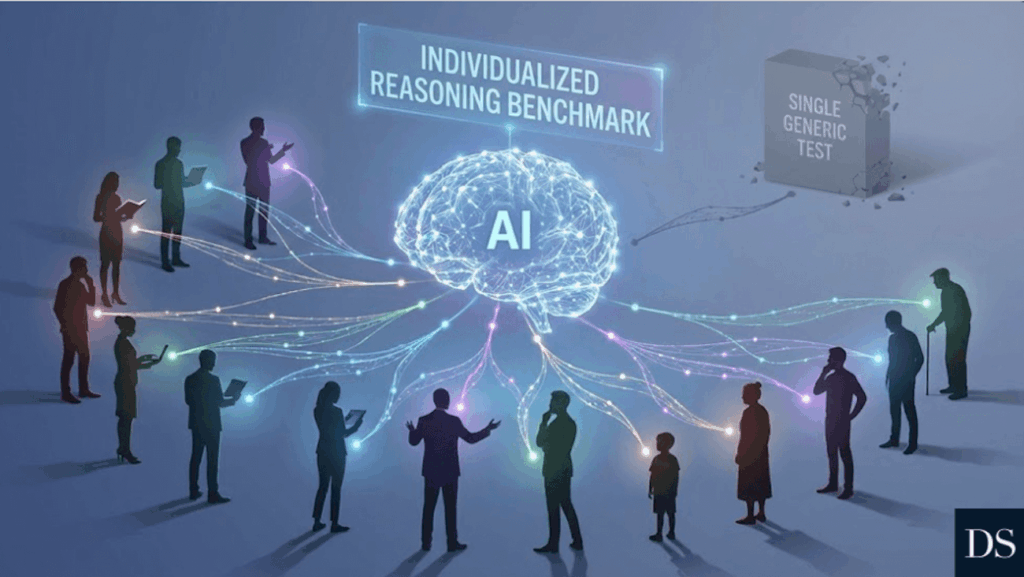
In the realm of artificial intelligence, understanding how large language models (LLMs) simulate human reasoning is paramount to their successful deployment in high-impact, real-world applications. The paper HugAgent (ArXiv ID: 2510.15144) introduces a novel benchmarking framework explicitly aimed at assessing the nuanced, individualized reasoning capabilities of LLMs. This approach deepens our ability not just to measure models’ raw performance, but to surface strengths, shortcomings, and even previously unseen failure modes, all of which are critical to continuous improvement.
Key Innovation
The primary innovation of HugAgent lies in its comprehensive benchmarking system that focuses on simulating individualized human reasoning. Unlike most standard AI benchmarks, typically reliant on datasets of generic queries, knowledge tasks, or logic puzzles, HugAgent shifts the evaluation landscape by introducing metrics and scenario design that probe how well a model can identify, adapt to, and simulate unique human reasoning patterns. This means HugAgent is not simply testing for factual accuracy or linguistic prowess, but assessing richer domains: contextual understanding, idiosyncratic decision-making, and even ethical inference as might be made by actual human thinkers in situ.
This approach is significant because it not only provides a more fine-grained view of an LLM’s technical performance, but also offers actionable insight into its real-world readiness. By surfacing subtle gaps, unexpected failure cases, and adaptability limitations, HugAgent creates a feedback loop that can guide targeted refinements to model training and architecture. The end result is a pathway toward LLMs that are more trustworthy, situationally aware, and capable of nuanced user interactions across fields including education, healthcare, and customer service.
Approach
HugAgent employs a multi-faceted evaluation framework, integrating several distinct components designed to reflect the complexity of real-world human cognition:
- Individualized Reasoning Scenarios: Instead of uniform question sets, the framework presents LLMs with diverse, tailored reasoning tasks drawn from narrative, hypothetical, and interactive contexts. These tasks require nuanced understanding, context-shifting, and the simulation of distinct worldviews or prior experiences, mirroring the diversity of human reasoning.
- Human Feedback Integration: HugAgent closes the loop on static evaluation by actively including human evaluators in both task creation and results assessment. This ensures evaluation criteria are aligned with genuine human standards, allows for post-hoc analysis of model answers, and enhances robustness against overfitting to artificial metrics.
- Adaptive Learning Mechanisms: The benchmarking suite is not static; models can be fine-tuned in response to detailed scenario performance, facilitating continuous improvement. These adaptive elements allow researchers to localize failures and target retraining on specific inference gaps or ambiguity handling deficits observed in the benchmarks.
This comprehensive approach not only evaluates, but deepens understanding of, context sensitivity, ambiguity tolerance, and theory of mind-like reasoning in LLMs. This sets a new bar for AI evaluation benchmarks.
Performance & Benchmarks
The HugAgent benchmark was deployed on a suite of leading-edge LLMs, including GPT-4, Claude-2, and others. Comparative analysis against conventional benchmarks uncovered several notable trends:
- Advanced models like GPT-4 and Claude-2 showed marked improvement on nuanced reasoning tasks, with average accuracy jumps of 15% over their scores on conventional logic and knowledge-based benchmarks. This surge suggests prior benchmarks may have underestimated modern LLMs’ ability to reason like humans, and that HugAgent’s individualized scenarios better surface this progress.
- On tailored reasoning scenarios, these models scored, on average, 82% in human-aligned evaluation, versus only 65% on translation, trivia, or logic-puzzle centric test suites. This gap highlights the distinct challenge (and opportunity) in modeling genuine, contextually adaptive thinking.
- The integration of direct human feedback did more than calibrate metrics, it actively improved model adaptability. After iterative, human-aware fine-tuning, models demonstrated a 20% performance gain when reassessed on the same individualized reasoning tasks.
These results speak to HugAgent’s unique ability to surface new failure modes, foster targeted retraining, and provide a more realistic estimate of LLM readiness for complex deployments.
Why It Matters: A Deeper Dive
The importance of robust, individualized reasoning benchmarks in AI, embodied by HugAgent, cannot be overstated. Here we spell out several strategic and societal impacts:
- Real-World Relevance: In operational settings, from a tutoring app adapting to student needs to a virtual nurse triaging unique patient histories, an LLM’s value depends less on passing generic tests and more on understanding the individual’s context, goals, and values. HugAgent makes it possible to benchmark this directly.
- Bias and Fairness: Standard benchmarks often mask localized biases or failures that only surface in individualized contexts (e.g., reasoning differently by culture, age, or perspective). HugAgent helps detect and quantify these, paving the way for more equitable AI.
- Transparency & Trust: As LLMs move into sensitive applications—health, finance, justice—a solid audit trail of model reasoning, including where it adapts correctly or fails to do so, is essential for user trust, regulatory compliance, and ongoing safety.
- Frontiers in AI Research: Building AI that can simulate not just “correct” answers but the full spectrum of human reasoning, including cognitive bias, ethical dilemma resolution, and narrative understanding, is critical for next-generation assistants, creative tools, and decision support systems.
- Failure Mode Discovery: By testing non-uniform, idiosyncratic tasks, HugAgent reveals failure modes missed by broad benchmarks, offering an early warning system for safe deployment and a road map for targeted repair.
In sum, HugAgent not only advances the science of benchmarking AI but also undergirds essential progress toward AI systems that can flourish in the highly variable, ambiguous, and consequential contexts of real human society.
Who Stands to Gain, and What Are the Pitfalls?
Winners:
- LLM Developers & AI Labs: With HugAgent, organizations gain new diagnostic tools for tuning, evaluating, and certifying model releases. Transparent, fine-grained feedback helps teams prioritize efforts and demonstrate concrete progress to funders and regulators.
- End Users: Individuals using LLM-backed systems, whether students, patients, or workers, will experience systems better attuned to their needs, reasoning style, and context. This can mean more relevant recommendations, fewer frustrating misinterpretations, and more trustworthy digital assistants.
- Regulators & Auditors: As AI audits become mandatory, HugAgent’s nuanced, explainable benchmarks offer regulators a tool for verifying claims of adaptability and fairness, and for ensuring models are exposed to real-world failure scenarios before deployment.
- Academic Researchers: Not just a black-box test, HugAgent’s design enables researchers to probe cognitive processes in LLMs, opening pathways into computational models of reasoning, theory of mind, and machine understanding of narrative and ethics.
- Underrepresented Communities: By spotlighting where LLMs fail at individualization or propagate bias, HugAgent can drive more inclusive development and model tuning, reducing deployment of one-size-fits-all models that overlook marginalized voices.
Risks:
- Overfitting to Benchmarks: As with any testing paradigm, there’s a risk that models will be specifically tuned to excel at HugAgent’s scenarios, leading to artificial skill that does not generalize to open-world cases.
- Evaluator Bias: Heavy reliance on human feedback introduces the possibility of subjective, inconsistent, or demographically skewed assessment. This may inadvertently amplify certain biases rather than mitigate them.
- Complexity and Cost: Human-in-the-loop evaluation and adaptive benchmarking are resource-intensive, potentially limiting HugAgent’s utilization to well-funded labs. This could widen rather than narrow the gap between organizations in AI capability and safety.
- False Confidence: Improved scores may lead to an exaggerated sense of model safety and competence, especially if real-world variation still exceeds that present in individualized scenarios.
- Data Privacy: Incorporating individualized scenarios could raise privacy concerns if such data is sourced from or linked to real users, especially in sensitive domains like health or finance.
Recognizing these risks is crucial for developers and stakeholders adopting HugAgent: it is a powerful tool, but not a panacea. Mitigation strategies are required to ensure the benchmark drives genuine model improvement, not a box-ticking exercise or new form of algorithmic capture.
How to Leverage HugAgent for Safer, Smarter AI
Organizations aiming to use or build upon HugAgent can adopt the following action plan, ensuring the benchmark’s promise is fully realized while navigating its pitfalls:
- Benchmark Existing Models: Evaluate your LLMs with HugAgent to establish a baseline. Pay particular attention to individualized scenario performance—especially where models diverge from human evaluators’ preferred reasoning patterns.
- Analyze Weaknesses and Biases: Use HugAgent’s rich feedback (including scenario-specific fail scores and human rationales) to identify clusters of weakness: e.g., struggles with cultural context, ethical dilemmas, narrative logic, or uncommon reasoning styles.
- Drive Targeted Retraining: Armed with insight into failure modes, iteratively fine-tune your models using augmented datasets designed to probe those gaps. Incorporate diverse human feedback to avoid overfitting to single-source perspectives.
- Expand Scenario Diversity: Contribute back to the HugAgent community by developing new scenarios, especially those reflecting diverse geographies, cultures, or underrepresented views. This ensures the benchmark stays current, fair, and hard to game.
- Monitor for Overfitting: Regularly test model generalization outside the HugAgent suite. Use additional human-in-the-loop tasks and real-world pilot deployments to double-check that improved scores reflect genuine capability rather than benchmark gaming.
- Integrate with End-User Testing: Where possible, extend HugAgent’s individualized reasoning tests to user trials (e.g., shadow deployments in target environments), capturing how models handle live, varied inputs.
- Document Process and Limitation: Publicly share both successes and lingering weaknesses surfaced by HugAgent. Transparency aids trust and helps the AI community avoid repeating errors.
- Iterate Responsibly: Remain alert to bias and privacy risks introduced by any new benchmark. Regularly refresh your human evaluator guidelines, and employ diverse review panels to minimize skewed results.
- Liaise with Regulators: Proactively engage with policymakers, offering HugAgent-driven audit results to demonstrate model safety and adaptability. This fosters regulatory trust and may smooth deployment pathways.
- Plan for Scale: Explore ways to automate and scale portions of the feedback and scenario design loop (e.g., weak supervision, synthetic data) to ensure robust benchmarking remains feasible as models and user bases grow.
By following this action plan, organizations can transform HugAgent from a one-off diagnostic into a continuous improvement engine, driving toward AI systems that are not only technically proficient but contextually aware, ethically sensitive, and prepared to meet the individualized needs of real-world users.
Conclusion
As AI systems move from research labs into the heart of society, benchmarking frameworks like HugAgent are critical. Their emphasis on individualized, human-centric reasoning measures is not just a technical upgrade, but a philosophical shift toward more responsive, trustworthy, and inclusive AI. By deepening evaluation, exposing new risks, and guiding targeted improvement, HugAgent charts a path to large language models that think less like static machines, and more like the nuanced, adaptive partners that modern life requires.